
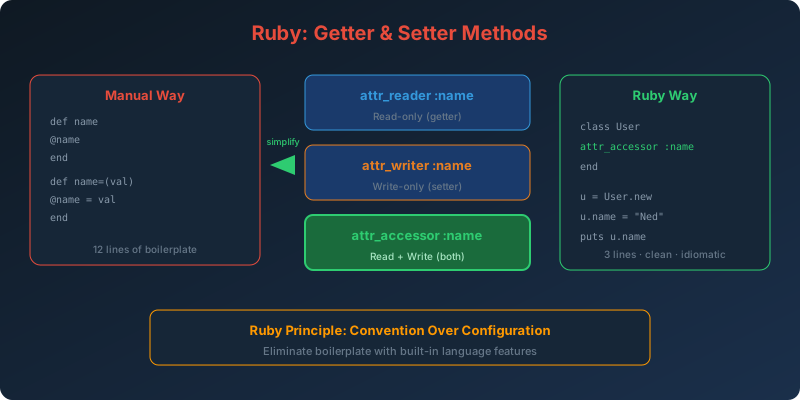
In the world of object-oriented programming, mastering getter and setter methods is important to effectively manage the state of objects. Ruby, with its most powerful weapon, elegant syntax, and other powerful features, offers a unique approach to these getter and setter methods. This article deep dives into the topic of getter and setter methods in Ruby.
What is a getter method?
If we need to access a value of a private variable from a class we use a getter method which is commonly known as accessor.
- accessor or getter
What is a settter method?
When we need to change the value of a variable, that is defined inside a class, we use a mutator method commonly known as setter method or writer method.
- mutator or setter or writer
Demonstration

To demonstrate this we will define a class named Car.
class Car
  def initialize(model, company, color)
    @model   = model
    @company = company
    @color   = color
  end
end
Now we make a new instance of the class named Car.
car = Car.new("Focus","Ford","White")Accessing variables
How do we get the values of the instance variables from the car object?
One way is to use the instance_variable_get method like this
puts "Car model is "   + car.instance_variable_get(:@model)
puts "Car company is " + car.instance_variable_get(:@company)
puts "Car color is "   + car.instance_variable_get(:@color)
Defining a custom getter method
A much simpler solution is to define a new getter method for each attribute.
class Car
  def initialize(model, company, color)
    @model   = model
    @company = company
    @color   = color
  end
  def model
    @model
  end
  def company
    @company
  end
  def color
    @color
  end
end
now we make a new instance of the class named Car
car = Car.new("Focus","Ford","White")now we get the instance variable values using getter methods
puts "Car model is "   + car.model
puts "Car company is " + car.company
puts "Car color is "   + car.color
Using Ruby’s built-in attr_reader method
It is much easier to get the value of the color instance variable with car.color than car.instance_variable_get(:@color)
The best way to make a getter method is to use the built-in Ruby attr_reader method which automatically creates getter methods for provided attributes
class Car
  attr_reader :model, :company, :color
  def initialize(model, company, color)
    @model   = model
    @company = company
    @color   = color
  end
end
Now we make a new instance of the class named Car
car = Car.new("Focus","Ford","White")Now we get the instance variable values using attr_reader
puts "Car model is "   + car.model
puts "Car company is " + car.company
puts "Car color is "   + car.color
Setting variables
To set instance variables inside the car object we can use the instance_variable_set method
First, define a class named Car
class Car
  def initialize(model, company, color)
    @model   = model
    @company = company
    @color   = color
  end
end
now we make an new instance of the class named Car
car = Car.new("Focus","Ford","White")to change the values of the color instance variable use instance_variable_set method
car.instance_variable_set(:@color,"Tango")Defining a custom setter method
or we could define a setter method
class Car
  def initialize(model, company, color)
    @model   = model
    @company = company
    @color   = color
  end
  # We define a setter method for color attributes inside the class
  def color=(new_color)
    @color = new_color
  end
end
car = Car.new("Focus","Ford","White")Let’s display the current values of instance variables
puts car.inspectlet’s change the color of the car using the setter method
car.color = "Tango"let us check if the color was changed
puts car.inspectthe color of the car now is Tango instead White
Using Ruby’s built in attr_writer method
Ruby provides the attr_writer method which provides setter methods for provided attributes, for example
class Car
  attr_writer :model, :company, :color
  def initialize(model, company, color)
    @model   = model
    @company = company
    @color   = color
  end
end
car = Car.new("Focus","Ford","White")Change instance_variable color
car.color = "Tango"Check if the value was changed
car.inspectDefine getters and setters in the same class
One way using attr_reader and attr_writer methods.
class Car
  attr_reader :model, :company, :color
  attr_writer :model, :company, :color
  def initialize(model, company, color)
    @model   = model
    @company = company
    @color   = color
  end
end
The easiest way is using the attr_accessor method.
class Car
  attr_accessor :model, :company, :color
  def initialize(model, company, color)
    @model = model
    @company = company
    @color = color
  end
end
 Never miss a story from us, subscribe to our newsletter