
The Problem
Your digital media application stores files that must be resilient to the loss of an entire Availability Zone. Some files are accessed frequently, others rarely, and the access pattern is unpredictable and changes over time. You need to minimize the total cost of storing and retrieving these files.
The Solution
Use S3 Intelligent-Tiering. It stores data across at least three Availability Zones, provides resilience to AZ loss, and automatically optimizes costs based on changing access patterns.
How It Works
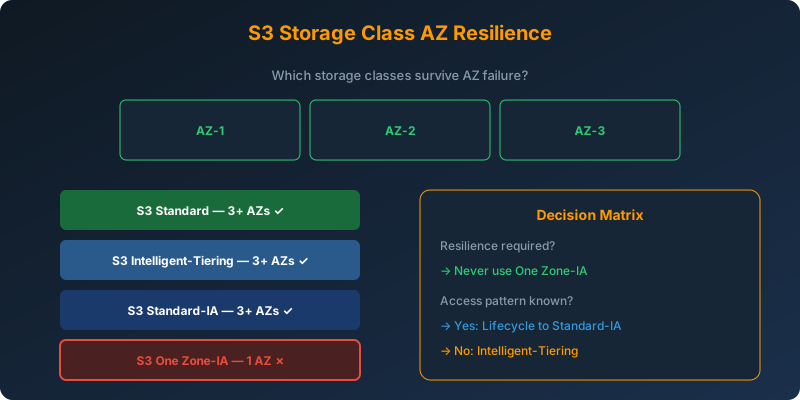
Storage Class Resilience Comparison
| Storage Class | AZ Redundancy | Survives AZ Loss? | Retrieval Fees |
|---|---|---|---|
| S3 Standard | 3+ AZs | Yes | None |
| S3 Intelligent-Tiering | 3+ AZs | Yes | None |
| S3 Standard-IA | 3+ AZs | Yes | Per-GB retrieval |
| S3 One Zone-IA | 1 AZ | No | Per-GB retrieval |
S3 One Zone-IA is immediately disqualified in any scenario requiring AZ resilience. It is cheaper but stores data in a single AZ, so it sacrifices the multi-AZ durability guarantee.
Why Not S3 Standard or Standard-IA?
- S3 Standard: Stores data across 3+ AZs and provides high availability, but you pay the highest storage rate regardless of access frequency. For files that are rarely accessed, this is wasteful.
- S3 Standard-IA: Lower storage cost, but charges retrieval fees. When access patterns shift unpredictably, a file that suddenly becomes popular accumulates retrieval charges.
- S3 Intelligent-Tiering: Moves objects between tiers automatically with no retrieval fees. The only cost is a small monitoring fee per object ($0.0025/1,000 objects/month).
Key Takeaways
- S3 One Zone-IA does not survive AZ failure. Never use it when resilience is required
- S3 Intelligent-Tiering, Standard, and Standard-IA all store data across 3+ AZs
- Intelligent-Tiering charges no retrieval fees when objects move between tiers
- Choose Intelligent-Tiering for unpredictable access patterns with resilience requirements
- The monitoring fee ($0.0025 per 1,000 objects) is negligible compared to the savings from automatic tiering
 Never miss a story from us, subscribe to our newsletter