
The Problem
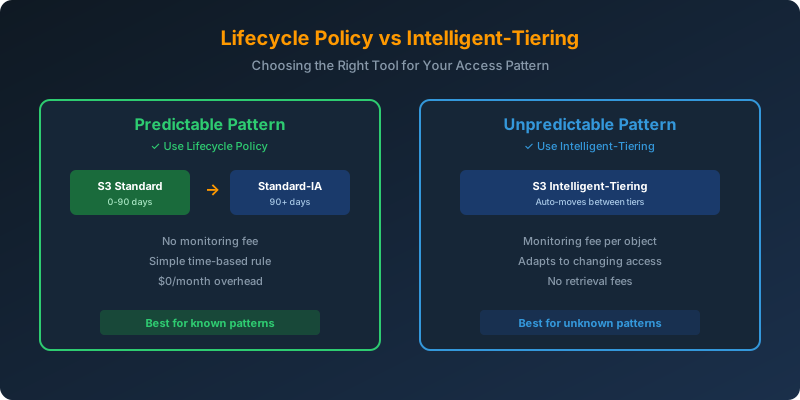
You have millions of files in S3 Standard. Downloads are frequent for the first 90 days, then drop off. You want to save money on storage without complicating your architecture.
The Solution
Implement an S3 lifecycle policy that moves objects from S3 Standard to S3 Standard-Infrequent Access (S3 Standard-IA) after 90 days.
1
2
3
4
5
6
7
8
9
10
11
12
13
14
15
16
17
aws s3api put-bucket-lifecycle-configuration \
  --bucket my-ringtones-bucket \
  --lifecycle-configuration '{
    "Rules": [
      {
        "ID": "MoveToIAAfter90Days",
        "Status": "Enabled",
        "Filter": {},
        "Transitions": [
          {
            "Days": 90,
            "StorageClass": "STANDARD_IA"
          }
        ]
      }
    ]
  }'
How It Works
S3 Standard-IA stores data you access less often but still need immediately when you do. The trade-off is straightforward:
| Feature | S3 Standard | S3 Standard-IA |
|---|---|---|
| Storage cost (per GB/month) | $0.023 | $0.0125 |
| Retrieval fee | None | $0.01 per GB |
| Availability | 99.99% | 99.9% |
| Durability | 99.999999999% | 99.999999999% |
| Min object size | None | 128 KB |
| Min storage duration | None | 30 days |
When access patterns are known and predictable, use a lifecycle policy. You avoid the per-object monitoring fee that Intelligent-Tiering charges.
Why Not the Alternatives?
S3 Standard-IA from day one — Your files are frequently accessed during the first 90 days. S3 Standard-IA charges a retrieval fee per GB. Frequent access on IA storage means high retrieval costs that offset any storage savings.
S3 Intelligent-Tiering — Intelligent-Tiering charges a small monitoring fee per object per month. When you already know the access pattern (frequent for 90 days, then infrequent), paying that fee on millions of objects is unnecessary overhead. Intelligent-Tiering is for unpredictable access patterns.
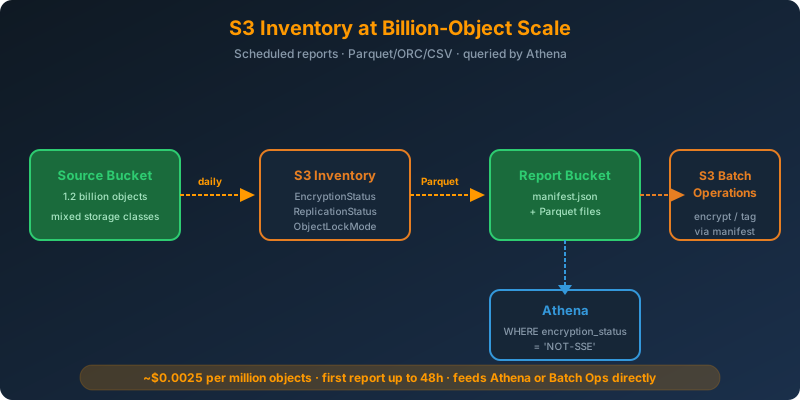
S3 Inventory to manage objects — S3 Inventory is a reporting tool, not a lifecycle management tool. It cannot move objects between storage classes on its own.
Key Takeaways
- Predictable access pattern = use S3 lifecycle policies (cheaper, simpler)
- Unpredictable access pattern = use S3 Intelligent-Tiering (automatic optimization)
- S3 Standard-IA has a 128 KB minimum object size and 30-day minimum storage duration
- S3 Standard-IA provides the same durability (11 nines) as S3 Standard
- Lifecycle policies are free to configure. You only pay for the storage class costs
 Never miss a story from us, subscribe to our newsletter