
The Problem
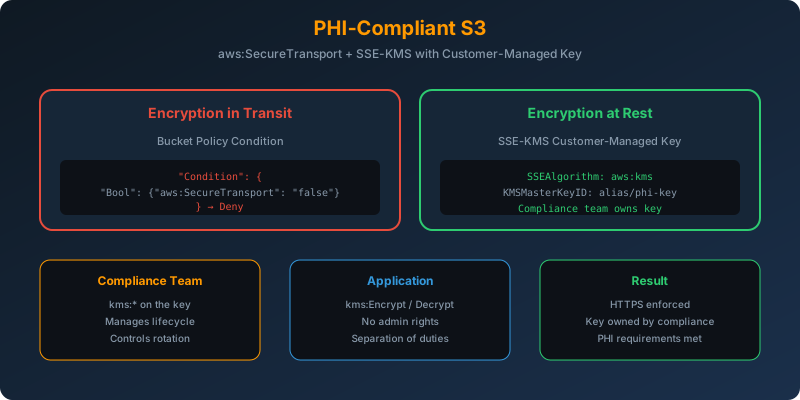
A hospital needs to store patient records in S3. Compliance requires:
- All PHI encrypted in transit
- All PHI encrypted at rest
- The compliance team must administer the encryption key
You need a solution that enforces both encryption boundaries and hands the compliance team full key control.
The Solution
Two layers:
- Bucket policy with
aws:SecureTransportcondition: rejects any request not using HTTPS/TLS (in transit) - Default encryption using SSE-KMS with a customer-managed key: compliance team owns the key policy (at rest)
How It Works
Step 1: Bucket Policy That Blocks Non-HTTPS
1
2
3
4
5
6
7
8
9
10
11
12
13
14
15
16
{
  "Version": "2012-10-17",
  "Statement": [{
    "Sid": "DenyInsecureTransport",
    "Effect": "Deny",
    "Principal": "*",
    "Action": "s3:*",
    "Resource": [
      "arn:aws:s3:::phi-records",
      "arn:aws:s3:::phi-records/*"
    ],
    "Condition": {
      "Bool": { "aws:SecureTransport": "false" }
    }
  }]
}
Any request over HTTP (not HTTPS) evaluates aws:SecureTransport as false and gets denied. Even if IAM would allow the action, the bucket policy deny wins.
Step 2: Create the KMS Key Owned by Compliance
1
2
3
4
5
6
7
8
9
10
11
12
13
14
15
16
17
18
19
20
aws kms create-key --description "PHI encryption key" \
  --policy '{
    "Version": "2012-10-17",
    "Statement": [
      {
        "Sid": "AllowComplianceAdmin",
        "Effect": "Allow",
        "Principal": { "AWS": "arn:aws:iam::123456789012:role/ComplianceTeam" },
        "Action": ["kms:*"],
        "Resource": "*"
      },
      {
        "Sid": "AllowS3UseOfTheKey",
        "Effect": "Allow",
        "Principal": { "AWS": "arn:aws:iam::123456789012:role/PhiApp" },
        "Action": ["kms:Encrypt", "kms:Decrypt", "kms:GenerateDataKey*"],
        "Resource": "*"
      }
    ]
  }'
The compliance team can manage rotation, disable the key, or delete it. Application roles can only use it.
Step 3: Set SSE-KMS as Default Bucket Encryption
1
2
3
4
5
6
7
8
9
10
aws s3api put-bucket-encryption \
  --bucket phi-records \
  --server-side-encryption-configuration '{
    "Rules": [{
      "ApplyServerSideEncryptionByDefault": {
        "SSEAlgorithm": "aws:kms",
        "KMSMasterKeyID": "alias/phi-encryption"
      }
    }]
  }'
Why Not the Alternatives?
ACM certificate on S3: You cannot attach an ACM cert to an S3 bucket endpoint. S3 provides its own TLS certificates automatically.
aws:SecureTransport + SSE-S3: SSE-S3 keys are fully AWS-managed. The compliance team cannot administer them. Fails the key administration requirement.
aws:SecureTransport + Macie: Macie is a discovery service, not an encryption service. It finds PII but doesn’t encrypt anything at rest.
Key Takeaways
aws:SecureTransportcondition in a bucket policy enforces HTTPS for all requests- SSE-KMS with a customer-managed key lets you separate key administration from data usage
- Split the KMS key policy: compliance team gets
kms:*, applications get onlykms:Encrypt/kms:Decrypt - S3 does not accept custom certificates; encryption in transit is enforced via bucket policy, not cert configuration
- Always use
Denyfor security-critical bucket policies; deny statements are the last word in policy evaluation
 Never miss a story from us, subscribe to our newsletter