
The Problem
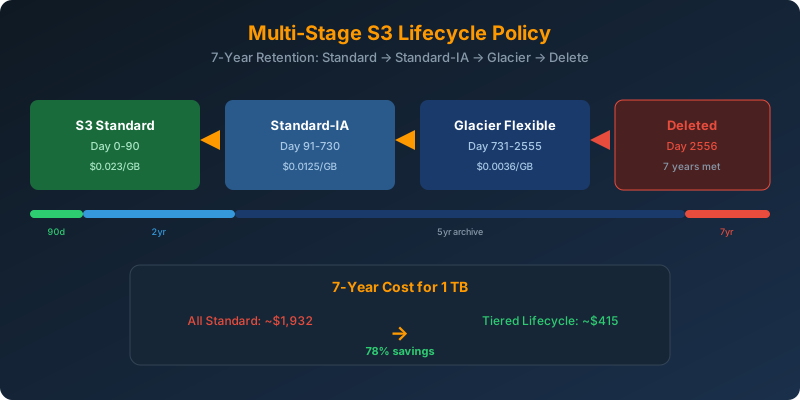
You store patient imaging files in S3 Standard. Regulations require 7-year retention. The access pattern is well-defined:
- First 90 days: actively accessed
- 90 days to 2 years: rarely accessed but needs immediate retrieval
- After 2 years: never accessed but must remain retrievable for compliance audits
- After 7 years: must be deleted
You want to minimize costs while fully automating the data lifecycle.
The Solution
Create a single S3 lifecycle rule with three transitions and an expiration:
1
2
3
4
5
6
7
8
9
10
11
12
13
14
15
16
17
18
19
20
21
22
23
24
25
26
aws s3api put-bucket-lifecycle-configuration \
  --bucket patient-imaging-bucket \
  --lifecycle-configuration '{
    "Rules": [
      {
        "ID": "PatientImagingLifecycle",
        "Status": "Enabled",
        "Filter": {
          "Prefix": "imaging/"
        },
        "Transitions": [
          {
            "Days": 90,
            "StorageClass": "STANDARD_IA"
          },
          {
            "Days": 730,
            "StorageClass": "GLACIER"
          }
        ],
        "Expiration": {
          "Days": 2555
        }
      }
    ]
  }'
How It Works
The lifecycle rule automates the entire 7-year journey:
1
2
3
4
Day 0-90:    S3 Standard        ($0.023/GB/month) — frequent access
Day 91-730:  S3 Standard-IA     ($0.0125/GB/month) — rare access, instant retrieval
Day 731-2555: S3 Glacier         ($0.0036/GB/month) — compliance archive
Day 2556:    Permanently deleted — retention period met
Cost Savings Example
For 1 TB of imaging data over 7 years:
| Strategy | 7-Year Cost |
|---|---|
| All S3 Standard | ~$1,932 |
| Tiered lifecycle (Standard → IA → Glacier → Delete) | ~$415 |
That is a 78% cost reduction with zero manual intervention.
Transition Constraints
S3 lifecycle transitions follow a waterfall model: you can only transition to a storage class that is lower in the hierarchy:
1
S3 Standard → Standard-IA → Intelligent-Tiering → One Zone-IA → Glacier Instant → Glacier Flexible → Glacier Deep Archive
Each transition must be to a class further down this chain. You cannot transition from Glacier back to Standard-IA using lifecycle rules.
Why Not the Alternatives?
Keep everything in S3 Standard: The most expensive option. For imaging data that is never accessed after 2 years, paying S3 Standard rates for the remaining 5 years is expensive.
Lambda function for transitions: S3 lifecycle policies are a native, fully managed feature that does exactly this. Writing custom Lambda code to replicate built-in functionality adds complexity, failure risk, and maintenance burden.
S3 Intelligent-Tiering: When the access pattern is this well-defined and predictable, lifecycle policies are cheaper. Intelligent-Tiering charges per-object monitoring fees and cannot automatically delete objects at a specific age; you still need a lifecycle rule for expiration.
Key Takeaways
- A single S3 lifecycle rule can define multiple transitions and an expiration in one configuration
- Transitions must follow the storage class hierarchy — you cannot move data back up
- For well-defined access patterns, multi-stage lifecycle policies are cheaper than Intelligent-Tiering
- The
Expirationaction permanently deletes objects. Use it to enforce retention policies automatically - S3 Glacier Flexible Retrieval costs ~$0.0036/GB/month with 3-5 hour standard retrieval
 Never miss a story from us, subscribe to our newsletter